
Co-Packaged Optics: The New Backbone of High-Reliability AI Clusters
Co-Packaged Optics: The New Backbone of High-Reliability AI Clusters
When AI Training Fails, It’s Rarely the Model
Most AI teams assume that training failures come from bad code, unstable frameworks, or misconfigured parameters. In reality, that’s no longer the main problem.
Recent cluster data tells a different story: nearly two-thirds of AI training interruptions are caused by hardware issues, not software. GPU and HPC hardware faults, switch and cable failures, NIC instability, and NCCL resets account for the majority of downtime. In many cases, the model is not the root cause of these failures.
As clusters scale, hardware fragility becomes the limiting factor, not algorithms.
Why Scaling AI Clusters Exposes Hardware Weaknesses
Modern AI training environments are dense, fast, and unforgiving. Once you move into large-scale, multi-rack deployments, small physical issues turn into system-wide failures.Common failure contributors include:
- Long electrical traces that degrade signal integrity
- High-speed copper links pushed beyond practical limits
- Switch and cable faults multiplying with scale
- Thermal stress inside 51.2T+ switch architectures
This is where Co-Packaged Optics (CPO) enters the picture, not as a luxury, but as a necessity.
What Changes with CPO
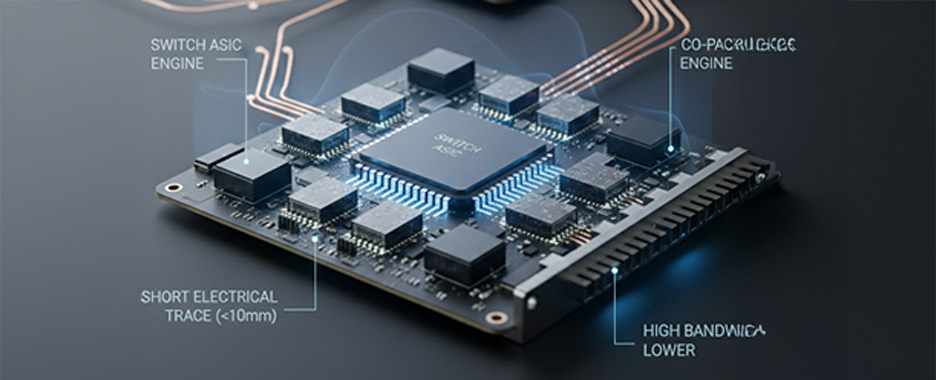
CPO is a system architecture where optical engines are placed directly adjacent to the switch or compute ASIC, instead of being located at the edge of the board as pluggable optical modules. CPO fundamentally rethinks where optics live in the system. That single design decision has outsized impact.1. Fewer Failure Points
By eliminating long, fragile electrical traces, CPO reduces the number of places where signals can degrade or fail. Less distance. Less noise. Less unpredictability.2. Lower Switch and Cable Fault Rates
With optics placed beside the ASIC, many traditional failure modes: connector issues, cable handling damage and signal loss across the board, simply disappear.3. Better Thermal Stability in Dense Switches
High-capacity switches (51.2T and beyond) generate serious heat. CPO architectures allow tighter thermal control and more predictable performance under sustained load.4. Reliable Scaling at High-Speed Lanes
At 100G+/200G+ per lane, optical I/O is no longer just faster. It’s more stable. Where copper struggles, optics remain consistent.Reliability is Now the Real Performance Metric
When 66% of cluster interruptions trace back to hardware fragility, improving reliability has a bigger impact than squeezing out marginal throughput gains. Switching from electrical to optical I/O isn’t just about bandwidth or power efficiency anymore. It’s about:- Fewer failed training runs
- Less unplanned downtime
- Predictable scaling behavior
- Higher overall cluster utilization
In short: resilience becomes the competitive advantage.
The future of AI infrastructure isn’t just faster.
Where izmomicro Fits In
At izmomicro, we’re focused on accelerating real-world CPO adoption across next-generation AI fabrics. That means practical engineering, not slideware.
We work across the ecosystem:
- Hyperscalers evaluating next-gen architectures
- Switch and ASIC teams designing CPO-ready platforms
- Optical module vendors pushing integration boundaries
- System integrators validating end-to-end reliability
If you’re building, testing, or evaluating CPO, whether through pilots, co-design efforts, or early lab validation. We’re ready to collaborate.
Let’s talk about what reliable AI infrastructure looks like at scale.
Blog Titles