
AI’s Next Big Challenge is Not Compute. It’s Heat.
AI’s Next Big Challenge is Not Compute. It’s Heat.
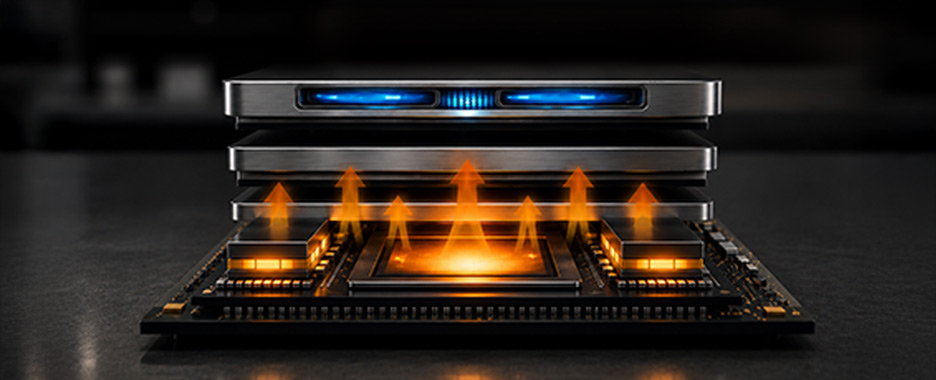
Everyone is discussing AI models, chips, and compute performance. But as AI infrastructure scales faster, heat management is emerging as the real bottleneck.
Modern AI racks are already operating at around 50–100 kW per rack, with next-generation platforms aiming for 200 kW+. At this level, the challenge is no longer just about achieving higher Floating Point Operations Per Second(FLOPS). It is about removing heat fast enough to maintain low junction temperatures and ensure reliability.
And this challenge becomes even more difficult as packaging technologies evolve.
Why Advanced Packaging is Changing the Thermal Equation
As AI systems become more compact and powerful, packaging technologies are driving significantly higher power density in smaller spaces. But with that shift comes a new level of thermal complexity.
Technologies accelerating this challenge include:
- 2.5D integration with interposers (GPU + HBM)
- 3D stacking
- Tighter chiplet layouts
As packaging density continues to increase, these architectures are creating localized hotspots, more complex thermal paths, and greater pressure on traditional spreaders and substrates. As a result, conventional thermal approaches are finding it increasingly difficult to keep up with these evolving demands.
Why Thermal Materials Alone Cannot Solve the Heat Problem
While advanced materials such as diamond-filled die attach and newer Thermal Interface Material (TIM) portfolios are advancing thermal performance, datasheet conductivity alone does not solve the issue. In real systems, failures often begin at the interface and integration level.
- TIM limits: Bondline thickness control, pump-out, voiding, and long-term stability can directly impact thermal performance.
- Heat spreaders and substrates: Traditional solutions may struggle to dissipate heat from small hotspots.
- Liquid cooling challenges: Dielectric behaviour, stability, corrosion compatibility, and serviceability remain key concerns.
- Phase-change and two-phase solutions: Performance may decline under cycling conditions and long-term reliability demands.
Ultimately, thermal management is no longer just about selecting high-conductivity materials, but ensuring the entire thermal path performs reliably under increasing power density.
The Focus is Now on Complete Thermal Path Optimization
Whether the application involves AI/HPC modules with dense packaging or high-power EV modules, the objective remains the same: achieve the lowest possible junction temperature while maintaining high reliability.
Achieving reliable thermal performance now requires more than simply selecting materials with high conductivity values. The larger challenge is finding, developing, and tailoring the highest thermal conductivity materials for a specific application, module architecture, and integration design. As AI infrastructure continues to evolve, heat management is becoming a defining factor in maintaining system stability, efficiency, and long-term reliability under rising power demands.
If you are facing challenges with power density, hotspot management, TIM/die-attach selection, or overall thermal path optimization in AI/HPC or high-power applications, connect with the experts at izmomicro.
Blog Titles
- Why Silicon Photonics Shifts...
- Smaller, Smarter, and Faster...
- Advanced Packaging: The New...
- Why Co-Packaged Optics...
- Co-Packaged Optics: From...
- Advanced Packaging for AI Accelerators...
- Co-Packaged Optics: The New Backbone...
- Advanced Packaging: The Bridge Between...
- First Silicon Bring-Up Starts with Packaging...
- Engineering the Future: Addressing Core...
- Why Advanced Packaging Will Determine...
- Photonics Meets MEMS: The...
- How Advanced Packaging is Reshaping...
- How Low-Power Optical Transceivers...
- Why Advanced Packaging is...a>
- Co-Packaged Optics: When Advanced ...
- System-Level Scaling in AI: When...
- AI’s Next Big Challenge is...