
Connecting the EV Ecosystem with Next-Gen RF Solutions
Connecting the EV Ecosystem with Next-Gen RF Solutions
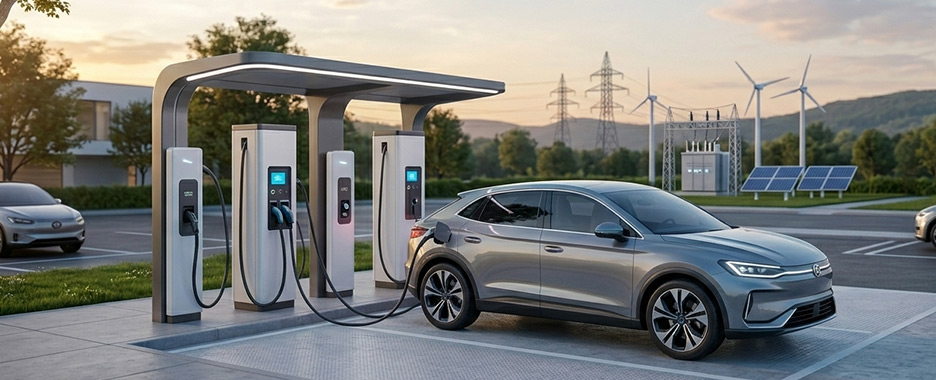
The global shift toward EVs is about far more than replacing internal combustion engines with batteries.
It represents the evolution of transportation into a connected ecosystem where vehicles, charging infrastructure, energy grids, and users must communicate seamlessly in real time.
Despite rapid advancements in EV technology, one challenge continues to slow the industry's progress: Connectivity.
Without reliable communication between these systems, even the most advanced EV infrastructure can struggle to deliver the seamless experience drivers expect.
The Connectivity Challenges Faced by Modern EVs
Today's EV ecosystem relies on constant data exchange. Drivers expect charging stations to display accurate availability, vehicles to communicate battery status, and operators to monitor infrastructure remotely.However, connectivity gaps often create friction throughout the user journey:
- Drivers arrive at charging stations only to find they are unavailable.
- Network interruptions prevent real-time monitoring and diagnostics.
- Charging operators struggle to balance power loads across multiple stations.
- Limited data visibility makes maintenance and fault detection more difficult.
Addressing the Infrastructure Bottleneck
At the heart of many of these challenges lies a communication bottleneck.Many vehicles, charging stations, and management systems still operate as isolated entities rather than parts of a connected network.
When communication breaks down, the entire ecosystem suffers.
A charger that cannot receive accurate battery data cannot optimize charging performance. Likewise, a station that fails to provide real-time updates can mislead drivers searching for available charging points. Even minor disruptions can result in longer wait times, reduced efficiency, and poor user experiences.
To build a truly intelligent EV ecosystem, the industry must strengthen the communication layer connecting every component.
The Role of Advanced RF and Communication Modules
This is where Radio Frequency (RF) and communication technologies become essential.
Acting as the nervous system of the connected EV ecosystem, RF modules enable fast, reliable, and low-latency communication between vehicles, charging stations, cloud platforms, and energy networks.
Vehicle-to-Everything Communication
RF technologies enable vehicles to communicate with surrounding infrastructure, supporting real-time data exchange that improves safety, navigation, traffic management, and charging efficiency.
Smarter Charging Infrastructure
Embedded communication modules allow charging stations to perform real-time monitoring, automated authentication, remote diagnostics, and dynamic load management. This helps improve uptime and create a smoother charging experience.
Building a Connected EV Future
Reliable connectivity unlocks new possibilities.Imagine an EV that automatically identifies the nearest available charger, reserves a slot, authenticates itself upon arrival, and completes payment without driver intervention.
At the same time, operators gain real-time visibility into network performance and equipment health.
This level of intelligence is only possible when every component remains connected.
izmo Microsystems is helping bridge the connectivity gap through advanced RF and communication modules engineered for reliability and performance. By strengthening communication between vehicles and infrastructure, izmo Microsystems is helping build a smarter, more connected, and more efficient EV future.
Blog Titles
- Connecting the EV Ecosystem...
- The Silicon Carbide Shift...
- Why Silicon Photonics Shifts...
- Smaller, Smarter, and Faster...
- Advanced Packaging: The New...
- Why Co-Packaged Optics...
- Co-Packaged Optics: From...
- Advanced Packaging for AI Accelerators...
- Co-Packaged Optics: The New Backbone...
- Advanced Packaging: The Bridge Between...
- First Silicon Bring-Up Starts with Packaging...
- Engineering the Future: Addressing Core...