
The Silicon Carbide Shift in Next-Generation EV Design
5-min read
The Silicon Carbide Shift in Next-Generation EV Design
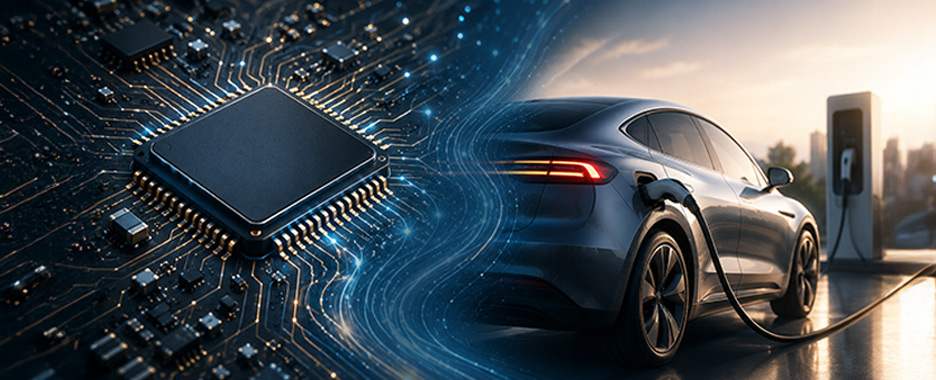
Conventional silicon has long formed the foundation of automotive power electronics. But as electric vehicle platforms transition toward higher switching frequencies, tighter thermal budgets, and increasingly common 800V architectures, the performance trade-offs of silicon-based devices are becoming more pronounced.
This is accelerating industry interest in silicon carbide (SiC). This wide-bandgap semiconductor is fast becoming the go-to choice for high-voltage EV electronics, particularly traction inverters and onboard chargers. As OEMs prioritize efficiency, power density, and thermal optimization, SiC is emerging as a preferred material platform for next-generation electric drivetrains.
The Design Limits of Conventional Silicon
Silicon IGBTs (Insulated Gate Bipolar Transistors) have delivered reliable performance across multiple EV generations and continue to remain viable in cost-sensitive and lower-voltage vehicle platforms. However, as EV architectures evolve toward higher voltage operation, switching efficiency and thermal management become increasingly critical design parameters.In high-power traction applications, silicon devices typically require trade-offs between switching frequency, thermal dissipation, and system efficiency. These constraints can influence cooling requirements, inverter packaging, and overall powertrain optimization. For manufacturers pursuing compact, high-efficiency power conversion systems, these architecture-level limitations are driving greater evaluation of wide-bandgap alternatives
How SiC Changes High-Voltage Power Conversion
Silicon carbide offers material properties that are particularly advantageous for high-voltage automotive applications, including a wider bandgap, higher critical electric field strength, and superior thermal conductivity compared to conventional silicon.In practical EV power electronics, these characteristics enable:
- Lower switching losses at higher voltages
- Improved thermal performance
- Higher switching frequencies
- Reduced passive component footprint
- Increased system-level power density
Rather than simply improving component-level efficiency, SiC enables broader architectural flexibility across powertrain design.
Final Thoughts: The Next Phase of EV Power Electronics
The transition toward SiC is no longer limited to premium EV programs.Industry forecasts indicate continued growth in wide-bandgap semiconductor deployment, driven by electrification demands and increasing system-level efficiency requirements. As manufacturing capacity expands and device costs continue to improve, SiC adoption is becoming commercially more viable across a broader range of vehicle segments. While gallium nitride (GaN) continues to gain traction in lower-power automotive applications, SiC currently remains the more established solution for high-voltage traction systems due to its commercial maturity and field-proven performance. As EV platforms continue to evolve, innovations in semiconductor materials will play a defining role in shaping inverter efficiency, thermal performance, and overall system architecture.
Engineering the next generation of EV power electronics? Let’s connect. izmo Microsystems delivers system-level engineering expertise required for high-voltage platforms. Whether you need advanced SiP packaging to reduce system footprint or thermal management solutions to control heat, we provide the architecture to power modern electrification.
Blog Titles
- The Silicon Carbide Shift...
- Connecting the EV Ecosystem...
- Why Silicon Photonics Shifts...
- Smaller, Smarter, and Faster...
- Advanced Packaging: The New...
- Why Co-Packaged Optics...
- Co-Packaged Optics: From...
- Advanced Packaging for AI Accelerators...
- Co-Packaged Optics: The New Backbone...
- Advanced Packaging: The Bridge Between...
- First Silicon Bring-Up Starts with Packaging...
- Engineering the Future: Addressing Core...